
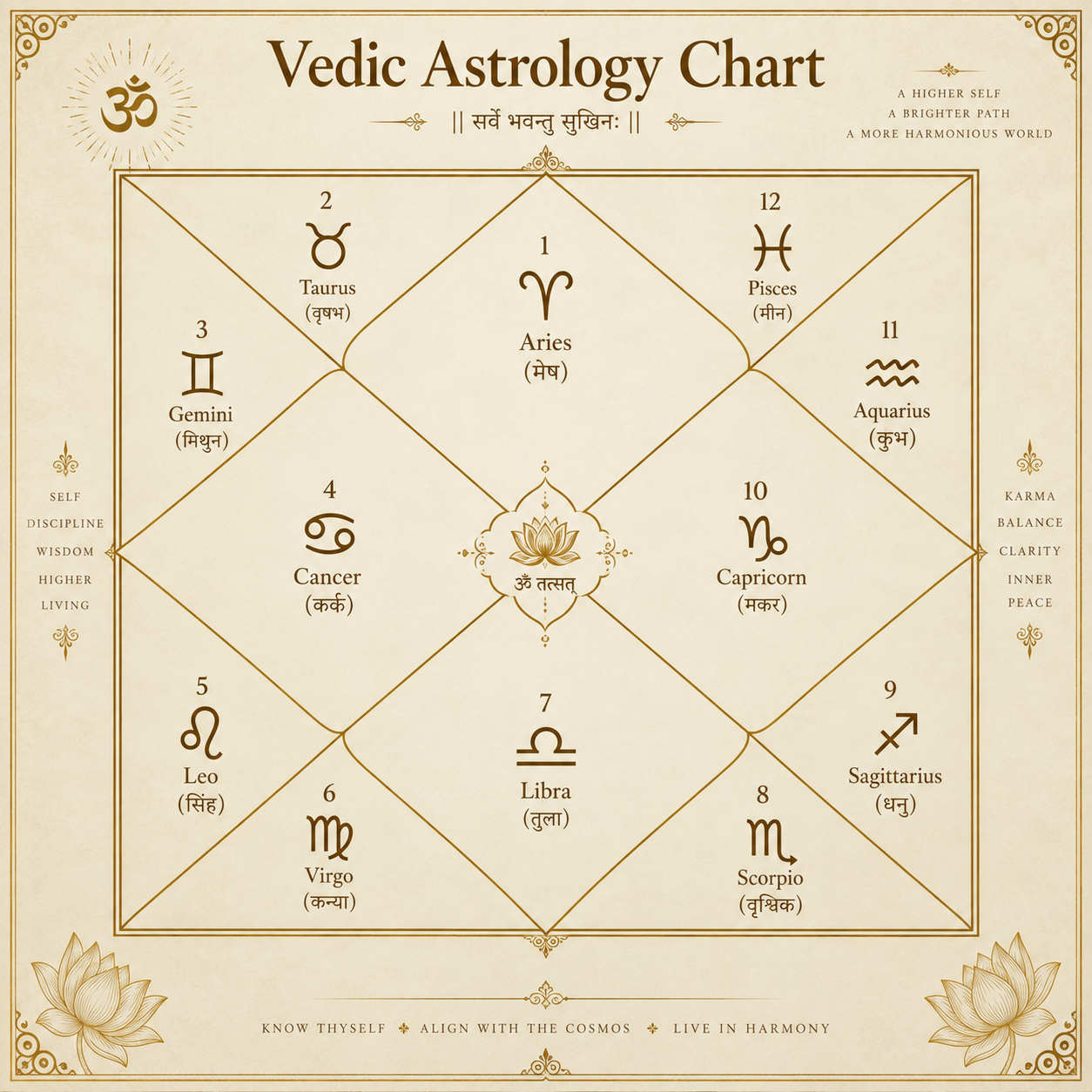
If you have ever opened a Vedic astrology birth chart and wondered why there are so many different charts, you are not alone. Along with the main birth chart, you may see charts labelled D1, D9, D10, D3, D4, D7, and D12.
So, what do these charts actually mean?
In Vedic astrology, these are called divisional charts, or Varga charts. Each one gives a more focused view of a particular area of life. The D1 chart provides the overall picture, while the other divisional charts help astrologers examine specific subjects in greater detail.
Classical Vedic astrology texts, including the Brihat Parashara Hora Shastra, describe different divisions of the zodiac and their role in horoscope analysis.
Think of it this way: your D1 chart is the main map, while the divisional charts are detailed maps of different parts of the journey.
Let’s understand the most commonly used ones.
D1 Chart: The Rashi or Birth Chart
The D1 chart, also called the Rashi chart, is the foundation of Vedic astrology.
It is calculated from the planetary positions at the exact time and place of birth. The D1 chart is used to understand the overall direction of life, including personality, health, relationships, career, finances, family, and major life themes.
If you are new to Vedic astrology charts, start with the D1. It gives the bigger picture before an astrologer moves on to more specific divisional charts.
The other charts are generally interpreted in connection with the D1 rather than completely separately.
D9 Chart: The Navamsa Chart
The D9 chart, better known as the Navamsa chart, is one of the most important divisional charts in Vedic astrology.
The Navamsa is traditionally associated with marriage, relationships, dharma, and the deeper strength of planets. It is particularly important when studying marriage and long-term partnerships. It plays an important role in dasha analysis; for eg if an exalted planet gets debilitated in Navamsa, it reduces the capability of planets to give benefic results. Similarly, a debilitated planet can be exalted in Navamsa and gain strength to give good results in its dasha and antardasha periods.
However, the D9 is not simply a “marriage chart.” It can also provide deeper insight into planetary strength and how certain themes in the birth chart may develop over time.
For this reason, astrologers often study the D1 and D9 together when analyzing relationships and the deeper potential of a horoscope. The position of every planet is analyzed in Navamsha to predict events in an individual’s life. Every yoga is again confirmed in Navamsha to verify its strength and intensity. For this reason, D-9 is also referred to as the fruit of the D-11 chart.
D10 Chart: The Dasamsa Chart
The D10 chart, known as the Dasamsa, is the divisional chart associated mainly with career and professional life. It represents the overall karma of an individual, desire to practice a particular career, and outlook towards professional aspects of life.
It can be used to study profession, work, reputation, achievements, responsibilities, and a person’s role in the wider world.
If the D1 gives a general indication of career, the D10 allows an astrologer to look more closely at the professional side of life.
This makes the D10 career chart especially useful when someone has questions about their profession, career direction, or changes in their working life.
D3 Chart: The Drekkana Chart
The D3 chart, or Drekkana, is traditionally associated with siblings, courage, initiative, and personal effort.
It can provide additional insight into relationships with brothers and sisters. It is also studied for qualities connected with courage, determination, and how a person responds to challenges.
The D3, therefore, looks at more than sibling relationships. It can also help explore how someone approaches obstacles and takes action in difficult situations. It also shows the ability to take risks and convictions to achieve goals and objectives in life. People having a strong D3 chart often challenge the status quo and bring new changes in professional, personal, and social aspects around them. It is the chart that also shows the leadership skills of a person.
D4 Chart: The Chaturthamsa Chart
The D4 chart, called Chaturthamsa, is associated with property, home, land, fixed assets, and material stability. It is a chart associated with the overall happiness of life. Along with material comforts, it provides deeper insight regarding the emotional state of a person. This chart plays a key role in the deep psychological state of a person.
When questions involve buying or owning property, gaining a home, relocation, or creating a stable material foundation, an astrologer may examine the D4 along with the D1 and other relevant factors.
D7 Chart: The Saptamsa Chart
The D7 chart, or Saptamsa, is traditionally connected with children, progeny, and parenthood.
Astrologers may study the D7 when examining matters related to children and the experience of becoming a parent. It clearly shows the attitude of a person towards children and the environment that shapes the mind and body of a child.
Like the other divisional charts, the D7 is not usually interpreted in isolation. The D1 and other relevant astrological factors provide the wider context.
In simple terms, the D7 helps an astrologer take a closer look at the part of life connected with children and parenthood.
D12 Chart: The Dwadashamsa Chart
The D12 chart, known as Dwadashamsa, is associated with parents, ancestors, and family lineage.
It can be studied to understand parental influences and themes connected with one’s family background.
The D12 offers a different perspective from the D1 by focusing more closely on the roots behind an individual’s story—particularly parents, ancestry, and inherited family influences.
Why Are Divisional Charts Important in Vedic Astrology?
One of the most interesting things about Vedic astrology is that a single birth chart does not have to answer every question.
Each divisional chart has its own area of focus.
- D1 – Rashi: Overall life and personality
- D9 – Navamsa: Marriage, relationships, and deeper planetary strength
- D10 – Dasamsa: Career and profession
- D3 – Drekkana: Siblings, courage, and personal effort
- D4 – Chaturthamsa: Property, home, and material stability
- D7 – Saptamsa: Children and parenthood
- D12 – Dwadashamsa: Parents, ancestors, and family lineage
The important point is that these charts are not seven separate horoscopes; they are different ways of looking at the same birth chart.
The D1 gives the larger picture, while the divisional charts help bring individual areas of life into sharper focus. An astrologer may compare several charts to understand whether a particular theme seen in the birth chart is supported by the relevant divisional chart.
This layered approach is one of the reasons Vedic astrology divisional charts are such an important part of traditional horoscope analysis.
Whether you are learning astrology for the first time or exploring your own birth chart, understanding D1, D9, D10, D3, D4, D7, and D12 is a useful first step.
After all, astrology is not just about looking at one chart. It is about understanding how different pieces of the cosmic picture come together.
However, before analyzing divisional charts, one must ensure the birth time is accurate. Calculation of divisional charts requires precision and accuracy. Otherwise, predictions based on divisional charts can be misleading.