

Imagine meeting someone you deeply click with—conversations flow effortlessly, values line up, and you see a future together. Then comes the horoscope match (Kundali Milan). A single word drops into the conversation, and suddenly everything halts: “Manglik.”
In many cultures, particularly across India, the label Manglik carries an almost supernatural weight. It has broken engagements, caused immense anxiety for parents, and burdened individuals with unnecessary guilt. But what does being Manglik actually mean? Is it a modern urban legend, or is there an underlying astrological logic that gets lost in translation?
What Does “Manglik” Actually Mean?
At its simplest, the word Manglik stems from Mangal, the Sanskrit name for the planet Mars. In Vedic terminology, having a Manglik Dosha (or Mangala Dosha) means that Mars occupies a prominent, influential position in a person’s astrological profile.
Contrary to popular belief, being Manglik isn’t a rare anomaly or a “curse.” In fact, because of simple geometry and planetary distribution, roughly 40% to 50% of the population can be categorized as Manglik in some form depending on how strictly a chart is analyzed.
The Core Connection: How Mars Intersects with Your Kundali
A Kundali(birth chart) is a 12-house map of the sky captured at the exact second, date, and location of your birth. Each of the 12 “houses” represents a different area of human life—from your health and wealth to career and marriage.
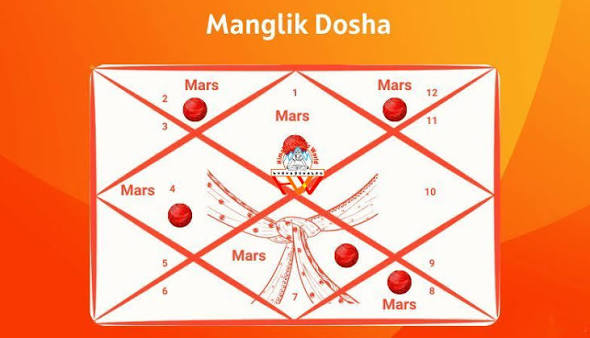
A person is declared Manglik when Mars sits in one of five or six specific houses in their Kundali (typically measured from the Ascendant, Moon, or Venus):
- 1st House (Self & Personality): Mars here makes a person direct, assertive, and energetic, but potentially quick-tempered or uncompromising in a partnership.
- 4th House (Home & Emotional Stability): Mars brings restless, chaotic, or volatile energy into domestic life and family harmony.
- 7th House (Marriage & Business Partnerships): Considered the most critical placement because the 7th house directly governs marriage. Mars here can cause friction, dominant behavior, or ego clashes between partners.
- 8th House (Longevity & Shared Assets): Mars sitting here is traditionally believed to create sudden disruptions, health challenges, or severe emotional strain within a marriage.
- 12th House (Private Life & Intimacy): Mars in the 12th house can reflect hidden frustrations, emotional distance, or mismatched physical expectations between spouses.
The Astrological Rationale: In classical Vedic astrology, Mars represents heat, fire, ambition, courage, and impulse. When this fiery planet occupies houses related to emotional bonding (4th), partnership (7th), or physical closeness (12th), its intensity can create friction if not channeled with self-awareness.
Myth vs. Behavioral & Astrological Reality
The fear surrounding Manglik status comes from centuries of exaggerated myths passed down through folk tradition. Separating fear from original astrological concepts paints a very different picture.
“Marrying a Manglik leads to early spouse death.”
- Extreme fear-mongering. Classical texts evaluate overall health, longevity houses, and planetary aspects — never a single planet in isolation.
“Mangliks must marry a tree or animal first.”
- Symbolic rituals (Kumbh Vivah) were local psychological customs, not universal astrological laws required by classical texts.
“A Manglik can ONLY marry another Manglik.”
- False. High Mars energy can be balanced (Dosha Bhanga) by strong Jupiter aspects, Saturn's placement, or simply mature conflict-resolution skills.
“It is a curse that ruins all relationships.”
- It signifies high drive and direct energy. Unchanneled, it causes arguments; channeled properly, it fuels passion, courage, and life momentum.
Real-Life Impact: Stories from Behind the Label
The real danger of Manglik Dosha isn’t planetary radiation—it’s societal anxiety.
1. The Broken Engagements
“We were happy together for two years. When our families met, her family’s astrologer declared I had a strong Manglik placement. Within a month, family pressure grew so intense that we had to call off the wedding.” — Rahul, 29
In many arranged marriage setups, stories abound where compatible, deeply committed couples are separated simply because one chart shows Mars in the 7th house while the other doesn’t.
2. The Internalized Guilt
Young individuals—especially women—often grow up hearing relatives talk about their “problematic” chart in hushed tones. This creates an internal complex where they feel defective or responsible for causing family stress, damaging their confidence in relationships.
3. Exploiting Parental Fear
Fear is a lucrative business. Unscrupulous practitioners frequently take advantage of panicked parents by prescribing expensive remedies, rituals, and gemstones to “cancel out” a natural planetary placement.
Reframing Mars: High Energy, Not High Hazard
In modern terms, being “Manglik” simply means having high energy, strong opinions, and drive.
If two people with high drive and unmanaged tempers enter a relationship without emotional maturity, clashes are inevitable. That’s not a cosmic curse—that’s human psychology. Conversely, if that high Mars energy is directed into shared goals, fitness, career pursuits, and healthy communication, Manglik individuals often make passionate, protective, and deeply resilient partners.
The Takeaway
It’s time to look past the superstition and treat Mars for what it really is: energy that needs direction, not fear.