If you’ve ever dipped your toes into astrology, you’re likely familiar with the 12 zodiac signs—from fiery Aries to intuitive Pisces. But in Vedic astrology (Jyotish), the 12 sun signs are just the broad strokes of the canvas. The real secrets of your personality, destiny, and cosmic DNA lie in the Nakshatras.
Welcome to Starverse’s deep dive into the 27 Lunar Mansions of the night sky—the ultimate celestial blueprint that explains why two people born under the same zodiac sign can be light-years apart in personality.
What Exactly is a Nakshatra?
The word “Nakshatra” translates to “that which does not decay” or “a star map.”
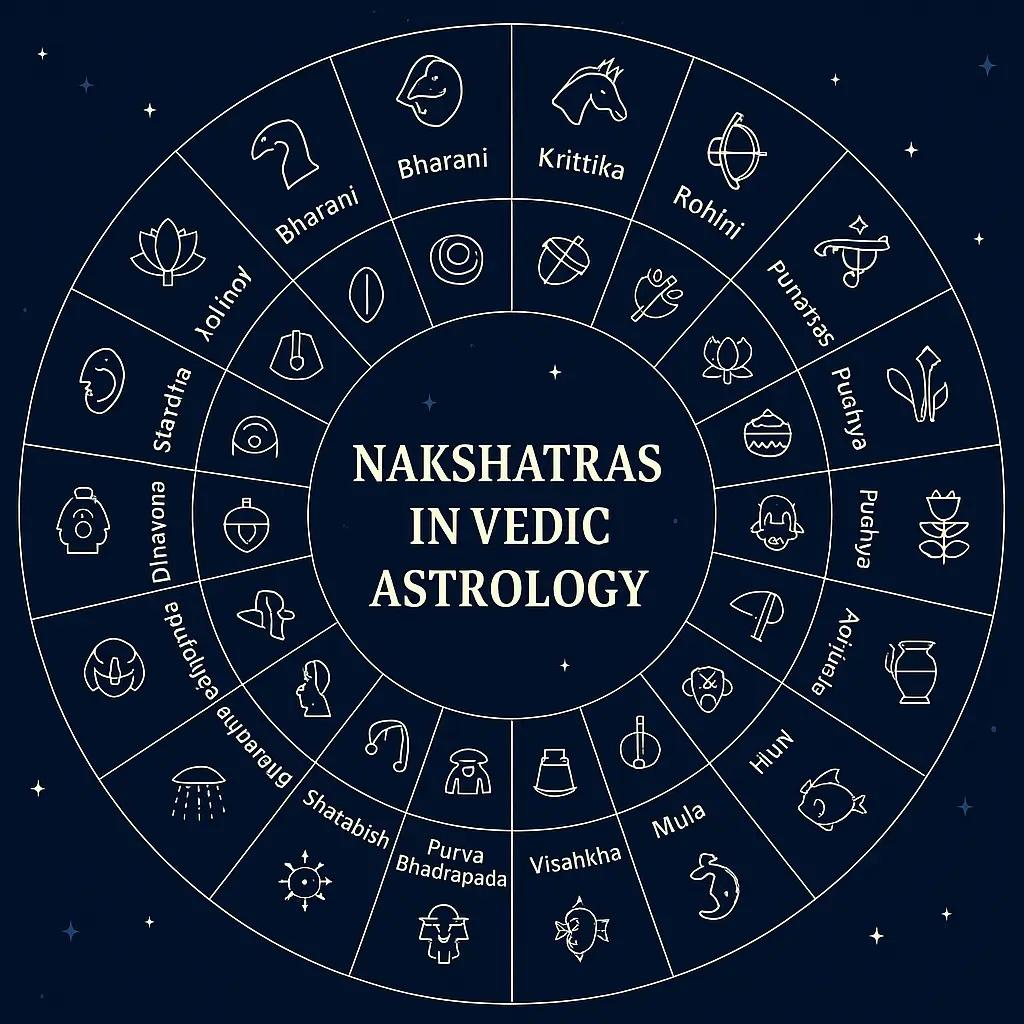
While Western astrology focuses heavily on the Sun’s annual journey through the 12 zodiac signs, Vedic astrology gives center stage to the Moon. As the Moon orbits Earth every month, it passes through 27 distinct star clusters or constellations. These 27 stellar stops are called Lunar Mansions or Nakshatras.
Think of the Zodiac Sign as the neighborhood you live in, while the Nakshatra is your specific street address. The zodiac sign tells us what energy is present, but the Nakshatra tells us how that energy actually behaves.
Each zodiac sign spans 30 degrees of the sky, while each Nakshatra spans exactly 13 degrees and 20 minutes. Together, these 27 Nakshatras form the complete 360° circle of the zodiac.
How Nakshatras Transform Your Chart Reading
In Vedic astrology, reading a chart without Nakshatras is like watching a movie without sound. Here is how they shape your horoscope:
1. Defining Your Janma Nakshatra (Moon Sign Star)
Your Janma Nakshatra is the specific star cluster the moon occupied at the exact moment you took your first breath. Because the Moon governs the mind, emotions, and subconscious reactions, your birth Nakshatra reveals your true inner nature, psychological patterns, and emotional baseline.
Lagna nakshatra defines personality, behavioral aspects of a person, and the body structure of an individual.
2. Unlocking the Vimshottari Dasha (Your Life Timeline)
Ever wondered why certain years bring immense success while others feel like a non-stop test of patience? Vedic astrology uses a 120-year planetary timeline system called the Vimshottari Dasha.
The Navtarasystem in astrology analyzes the dasha period and the impact of a planet on a person’s life. The position of planets’ nakshatra is counted from the natal (birth) nakshatra of the moon. For example, if the moon is in Ashwani nakshatra and Jupiter is in Kritika, it is the 3rd from janam nakshatra, and this cycle repeats after a cycle of 9 nakshatras.
- Janam Nakshatra (1, 10, 19)—It shows self, health, physical body, and immunity.
- Sampat Nakshatra (2, 11, 20)—wealth, prosperity, and material gains.
- Vipat tara Nakshatra (3, 12, 21)—challenges and obstacles.
- Kshema Nakshatra (4, 13, 22)—comforts, well-being, and happiness.
- Pratyari Nakshatra (5, 14, 23)—conflicts, opposition, legal disputes.
- Sadhna Nakshatra (6, 15, 24)—success, achievements through focus and dedication.
- Vadha Nakshatra (7, 16, 25)—destruction, unexpected events, and transformations.
- Mitra Nakshatra (8, 17, 26)—friendship, support, partnership, and relationships.
- Param mitra Nakshatra (9, 18, 27)—favorable luck and divine grace.
Your personal life timeline is determined entirely by your Moon Nakshatra and its ruling planet. Without Nakshatras, timing future life events with precision would be impossible.
3. Personalizing Planet Behaviors
Two people can both have Mars in Aries, but if one has Mars in Ashwini and the other in Krittika, their actions will look completely different. The Ashwini person acts impulsively like a swift healer or racer, while the Krittika person acts with sharp, burning determination like a warrior cutting through obstacles.
The Operational Natures: How the Stars Function
While every star has its own distinct personality, astrologers group Nakshatras into functional categories based on their operational style. Knowing these helps you align your actions with cosmic timing:
- Fixed Stars (Sthira): Rohini, Uttara Phalguni, Uttara Ashadha, Uttara Bhadrapada
Vibe: Grounded, steady, and long-lasting. Best for laying foundations, starting businesses, or long-term commitments. - Movable Stars (Chara): Punarvasu, Swati, Shravana, Dhanishta, Satabhisha
Vibe: Dynamic, adaptable, and active. Best for travel, purchasing vehicles, and starting health routines. - Sharp Stars (Tikshna): Ardra, Aslesha, Jyeshtha, Mula
Vibe: Fiery, intense, and transformative. Best for breaking old habits, research, removing toxins, or ending unhealthy situations. - Soft Stars (Mridu): Mrigashira, Chitra, Anuradha, Revati
Vibe: Gentle, artistic, and peaceful. Best for creative projects, romance, building friendships, and self-care. - Light Stars (Laghu): Ashwini, Pushya, Hasta
Vibe: Quick, efficient, and uplifting. Best for quick transactions, learning new skills, and healing work.
An important aspect of using nakshatras in Vedic astrology is to study deities and symbols related to particular nakshatras. For example, the Ardra Nakshatra, ruled by Rahu, is represented by a teardrop, which represents emotional release, sorrow, and purification that comes after crying or a cathartic storm. It becomes the theme for the planet sitting in that nakshatra. The presiding deity is the Rudra, the fierce god of thunder; it again represents destruction for new creation. Similarly, other nakshatras will have other themes based on symbols and deities that shape the life of an individual.
The 27 Lunar Stars at a Glance
Each of the 27 Nakshatras carries a unique symbol, ruling deity, and planetary influence:
| Nakshatra | Title | Traits |
|---|---|---|
| Ashwini | The Star of Transport | Swift healing, pioneering energy, action-oriented. |
| Bharani | The Star of Restraint | Creative intensity, deep transformation, passionate. |
| Krittika | The Star of Fire | Sharp intellect, protective nature, cutting truth. |
| Rohini | The Star of Growth | Magnetic charm, artistic taste, luxury, creation. |
| Mrigashira | The Searching Star | Curiosity, continuous exploration, gentle nature. |
| Ardra | The Star of Renewal | Emotional breakthroughs, transformation through storms. |
| Punarvasu | The Star of Return | Resilience, second chances, optimism, nurturing. |
| Pushya | The Star of Nourishment | Spiritual wisdom, protective care, highly auspicious. |
| Aslesha | The Clinging Star | Deep intuition, strategic thinking, mystical intellect. |
| Magha | The Royal Star | Ancestral lineage, leadership, nobility, authority. |
| Purva Phalguni | The Star of Pleasure | Relaxation, romance, creative arts, leisure. |
| Uttara Phalguni | The Star of Patronage | Reliability, contracts, leadership, commitment. |
| Hasta | The Golden Hand | Craftsmanship, dexterity, clever humor, skill. |
| Chitra | The Star of Opportunity | Visual beauty, design, structural genius, charisma. |
| Swati | The Independent Star | Freedom-loving, diplomatic, adaptable, independent. |
| Vishakha | The Star of Purpose | Unwavering focus, goal-oriented fire, ambition. |
| Anuradha | The Star of Success | Loyalty, deep friendship, devotion, and cross-cultural bonds. |
| Jyeshtha | The Chief Star | Seniority, protective instincts, hidden strength. |
| Mula | The Root Star | Radical truth, unearthing secrets, spiritual shifts. |
| Purva Ashadha | The Invincible Star | Confidence, persuasive speech, pride, strength. |
| Uttara Ashadha | The Universal Star | Lasting victory, ethical leadership, endurance. |
| Shravana | The Star of Hearing | Deep listening, learning, preservation of wisdom. |
| Dhanishta | The Star of Symphony | Rhythm, abundance, musical talent, popularity. |
| Shatabhisha | The 100 Physicians | Healing mysteries, technology, visionary solitude. |
| Purva Bhadrapada | The Mystical Fire | Passionate conviction, transformative insights. |
| Uttara Bhadrapada | The Deep Water | Spiritual maturity, wisdom, meditation, and patience. |
| Revati | The Wealthy Star | Final completion, unconditional love, safe journeys. |
Discover Your Cosmic Blueprint
Your Sun sign might show the world how you project yourself, but your Moon Nakshatra reveals who you are at your core. Exploring these 27 stellar energies unlocks a richer, more personal map of your talents, desires, and emotional nature.
Frequently Asked Questions (FAQ)
What is the main difference between my Zodiac Sign and my Nakshatra?
Your Zodiac Sign represents a broad 30° slice of the sky governed by a planet, showing your general traits and outer personality. Your Nakshatra is a much more specific 13°20′ star cluster within that sign that governs your inner mind, emotional instincts, and core psychological motivations.
Why is the Moon Nakshatra considered more important than the Sun Nakshatra in Vedic Astrology?
In Vedic astrology, the Moon represents the mind, perceptions, and emotional well-being. Since your experience of life is filtered through your mind, the position of the Moon at birth (your Janma Nakshatra) reveals how you react to life’s events and forms the basis for timing major life events.
Can two people have the same zodiac sign but different Nakshatras?
Absolutely! Each 30° zodiac sign contains two to three different Nakshatras. For example, someone with the Moon in Taurus could fall under Krittika, Rohini, or Mrigashira—giving each person a completely different personality, motivation, and approach to life despite sharing the same sign.
How do Nakshatras help in predicting future life events?
Your birth Nakshatra determines the starting point of your Vimshottari Dasha—the 120-year planetary cycle system used in Vedic astrology. By tracking which planet rules your active Dasha period based on your Nakshatra, astrologers can accurately predict major shifts, achievements, and challenges throughout your life.